

What is AffixIO in plain terms?
AffixIO is a verification layer for automated decisions. When a payment gateway, AI agent, access system, or eligibility workflow needs to know whether something is allowed, AffixIO evaluates your policy and returns a binary outcome: yes or no. That outcome includes signed proof metadata your auditors, risk teams, and downstream services can verify later.
Organisations adopt AffixIO when they need verification for AI, stateless identity verification, and no PII eligibility checks at the decision boundary rather than another datastore full of sensitive records. It is the truth layer: the narrow gate where action is permitted or refused with evidence.
The problem AffixIO addresses
Modern systems make thousands of small decisions every day. Can this payment proceed? Should this agent call that tool? Is this person eligible for this programme? Does this visitor belong in this building? Can this merchant trust the AI agent at checkout?
Most organisations answer these questions in one of two unsatisfactory ways. Either they copy sensitive records into yet another database and hope nobody misuses them, or they rely on opaque checks that cannot be replayed, audited, or defended when something goes wrong.
Search demand for AI agent payment verification, how merchants verify AI agent identity during checkout, audit trails for AI agent decisions, and AML KYC stateless verification reflects the same underlying tension. Teams want proof without data sprawl. AffixIO exists for that requirement.
AffixIO gives teams a clear binary answer they can stand behind. Not a probability. Not a silent score. Not a guess from a model with no paper trail. A yes or a no, with evidence attached.
What AffixIO is
AffixIO is a verification layer. It evaluates policy against the facts you supply for a single request, then returns an allow or deny outcome with a signed proof reference your systems can store, replay, and audit.
Think of it as the truth layer: the place where automated decisions, including those made or proposed by AI agents, are grounded in rules you define rather than assumptions buried in code.
AffixIO is stateless by design at the verifier boundary. It does not build a long-lived profile of everyone who passes through. It does not hold sessions. It does not become another system of record. It decides, signs, and moves on.
Patent pending GB2510622.0 — System and Method for Stateless Binary Eligibility Verification Using Live External Data.
What is a truth layer?
A truth layer is not a chatbot, a CRM, or a data lake. It is the decision surface where your organisation commits to an answer. AffixIO occupies that surface for yes/no questions that matter: payment authorisation, agent tool use, programme eligibility, facility access, consent verification, and compliance checkpoints.
Without a truth layer, AI agents self-authorise, payment flows depend on hidden heuristics, and auditors reconstruct decisions from scattered logs. With AffixIO, the answer is explicit, signed, and bounded to the policy you declared for that request.

Verification for AI agents and agentic payments
Agentic AI changes the risk model. An agent can initiate transfers, modify records, call external tools, and act at machine speed. Teams searching for AI agent verification, AI agent spending controls, agentic payments verification, and how issuers verify AI agents during authorisation are really asking one question: who authorises the agent before the action happens?
AffixIO answers that question at the boundary. Before an agent moves funds, opens a privileged integration, or completes a delegated payment, your stack requests verification. AffixIO returns allow or deny with proof. Downstream enforcement blocks or permits the action based on that signed outcome.

Common AI verification scenarios
- Merchant checkout: verify the agent identity and spending policy before card authorisation
- Treasury operations: cap daily transfers and require a fresh check for each batch
- Tool access: allow or deny API calls based on role, scope, and risk policy
- Delegated payments: verify consent and limits before agent-initiated spend
- Audit trails: retain signed outcomes for AI agent decision review without raw PII copies
Read the AI Integration guide for implementation paths. For security review material, see the Trust Center.
Stateless identity verification and no PII at the verifier
Stateless identity verification means the verifier does not accumulate a standing record of everyone checked. Each request is evaluated independently. The answer is signed. The proof can be stored. The person's underlying records stay in the systems that already own them.
This matters for teams pursuing no PII eligibility checks, privacy-preserving verification, digital sovereignty, and zero data egress strategies. AffixIO is positioned so the verifier boundary does not become another PII warehouse by default.

That does not mean verification is anonymous or unaccountable. It means the audit artefact is the signed outcome and policy reference, not a duplicated identity file at every vendor in the chain.
How AffixIO works, without exposing internals
You send a request containing the minimum information needed to run your policy. AffixIO checks that request against authorised sources and your rules. It responds with a single outcome and a proof reference. Your application acts on that outcome. Your audit trail keeps the proof, not a copy of everyone's personal data.
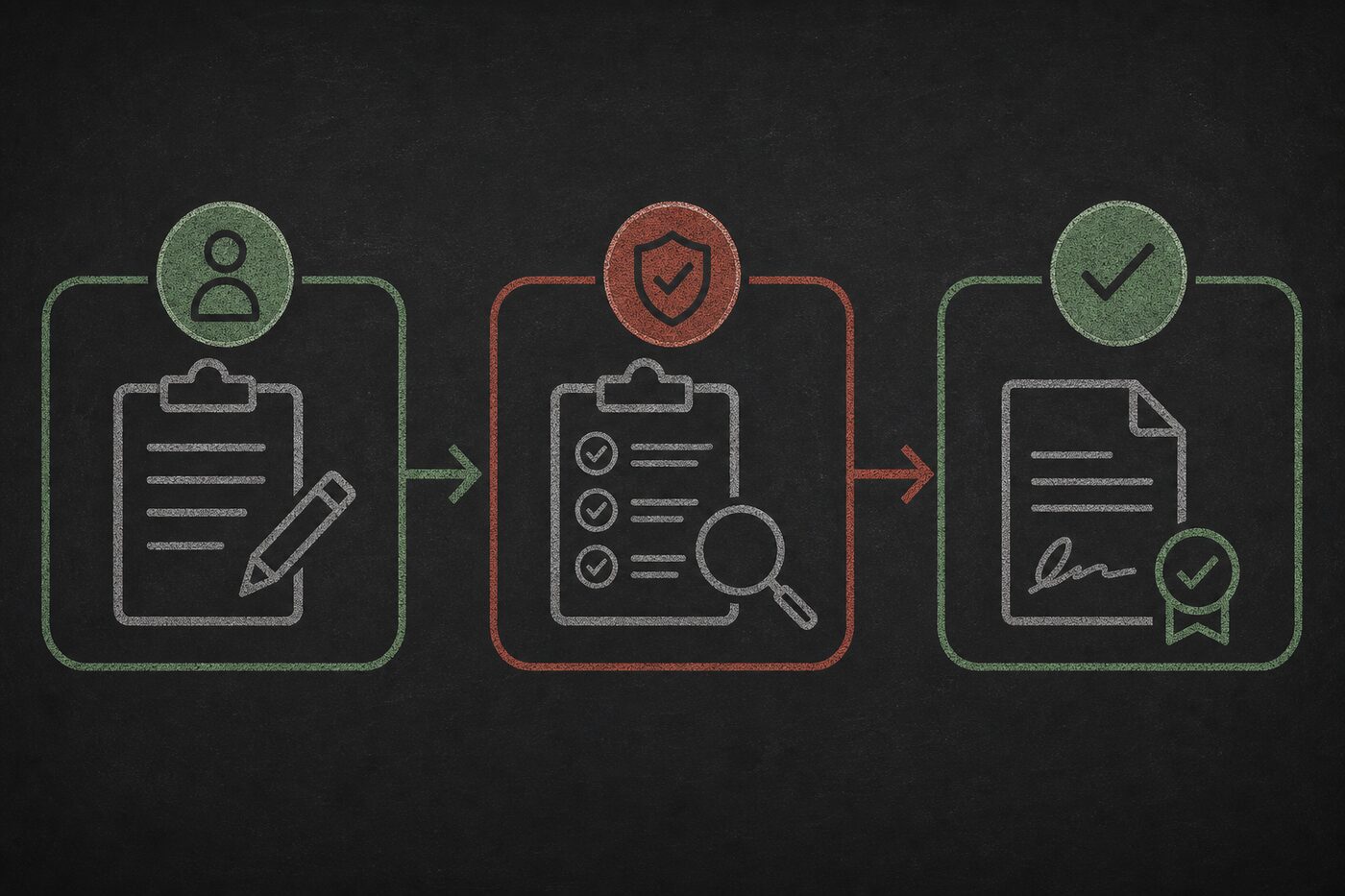
The important part is what stays out of the picture. AffixIO is not where customer records live. It is not where marketing segments are built. It is the narrow gate where a decision must be made, recorded, and defended.
Typical request lifecycle
- Your application, agent, or gateway prepares a verification request with policy inputs
- AffixIO evaluates authorised sources against your declared rules
- AffixIO returns allow or deny with a signed proof reference
- Your system enforces the outcome and stores proof metadata for audit
- Reviewers replay the decision path without needing a duplicate identity store at the verifier
What AffixIO does and does not do
AffixIO does
- Evaluate explicit policy on every request
- Return binary allow or deny outcomes
- Attach signed proof metadata for audit and replay
- Provide verification for AI agents before they act
- Support online and offline-capable verification patterns
- Keep the verifier boundary lean on retained personal data
- Give security and compliance teams evidence they can review
- Enable eligibility verification across payments, government, insurance, and access control
- Support consent receipt and automated decision verification workflows
AffixIO does not
- Replace your core systems of record
- Build hidden customer profiles or behaviour scores
- Hold standing identity sessions at the verifier
- Guarantee your regulatory compliance on its own
- Store the underlying personal data from every check by default
- Make decisions without a traceable policy path
- Act as a general-purpose AI model or chat interface
AffixIO vs traditional verification approaches
AffixIO is not a CRM, a data warehouse, an identity provider, or a general-purpose AI platform. It does not try to know everything about a person. It tries to answer one bounded question well, with proof.
| Common approach | AffixIO truth layer approach |
|---|---|
| Copy records into a central store for every check | Evaluate per request with minimal data at the verifier |
| Return fuzzy scores or model confidence | Return explicit allow or deny with signed proof |
| Let AI agents act first and explain later | Verify before high-risk actions, tools, or transfers |
| Audit by searching through raw personal data logs | Audit by reviewing signed outcomes and policy references |
| Assume connectivity is always available | Support mixed-connectivity patterns where decisions must still hold |
| KYC stack becomes a permanent identity cache | Stateless verification boundary with proof-first audit model |
| Merchant cannot verify agent identity at checkout | Signed agent verification before authorisation proceeds |
Agentic payments, banking, and merchant verification
Delegated and agent-initiated payments are among the fastest-growing verification searches in 2026. Teams ask how merchants verify AI agent identity during checkout, how issuers verify agents during authorisation, and how to retain audit trails for AI agent decisions without expanding PCI and GDPR scope.
AffixIO sits at that authorisation moment. A merchant, issuer, or treasury system requests verification. Policy covers identity signals, limits, consent state, and risk boundaries you define. AffixIO responds with allow or deny and signed proof. The payment rail or wallet enforces the result.

This model supports financial eligibility verification, employment eligibility checks, payment fraud prevention gates, and compliance verification workflows where the decision must be explicit and reviewable.
Examples in practice
AffixIO is built for any workflow where a yes or no must be defensible. Below are common patterns drawn from payments, access control, government programmes, and AI governance.

AI agent payment gate
An autonomous agent requests a transfer. Policy caps daily spend. AffixIO returns deny with proof. The agent cannot proceed until a fresh check passes under updated rules.

Facility entry
A badge and shift window arrive at the access layer. AffixIO confirms the visitor is authorised for this site and time. The door unlocks. The audit log stores the signed outcome, not raw badge payloads.

Programme eligibility
A housing support application is assessed against residency, income band, and status rules. AffixIO returns allow with proof. Case workers see a clear yes. Source records remain in the systems that already own them.
More verification patterns AffixIO supports
- Insurance underwriting eligibility with signed allow or deny at quote boundary
- Employment screening gates with proof-backed outcomes for HR audit
- Consent receipt verification before agentic transactions proceed
- Government digital identity programme checks with minimal verifier retention
- Retail restricted-product purchase eligibility at checkout
- Healthcare benefit tier checks without copying full patient records to the verifier
- Logistics yard and dock authorisation for role-based access
- Utilities subsidy qualification with regional policy gates
Who AffixIO is for
AffixIO is for organisations that operate at decision boundaries: where money moves, access is granted, benefits are awarded, agents take action, or compliance must be demonstrated.
Where AffixIO fits in your stack
AffixIO sits beside the systems you already trust. Your applications, agents, and gateways call AffixIO when a decision is required. Your databases, identity platforms, and case management tools stay where they are. AffixIO adds a narrow, provable decision point rather than another data silo.
For AI workloads, agents do not self-authorise. They request verification. AffixIO returns allow or deny. Downstream systems enforce the outcome. For regulated environments, auditors can follow a straight line from policy to signed result without wading through copies of personal data scattered across vendors.
For teams comparing offline verifiable credentials, zero-knowledge proof authentication positioning, and stateless verification models, AffixIO provides the decision layer that turns policy into a signed yes or no your stack can act on.
Frequently asked questions about AffixIO
What is AffixIO used for?
AffixIO is used wherever a system needs a defensible yes or no: AI agent verification, payment authorisation, programme eligibility, access control, consent checks, and compliance gates. It returns signed proof with each outcome.
How is AffixIO different from a traditional identity provider?
An identity provider establishes who someone is and often maintains sessions or profiles. AffixIO evaluates a specific policy question per request and returns allow or deny with proof. It is a truth layer, not a standing identity directory.
Can AffixIO help with AI agent payment verification?
Yes. AffixIO is built for verification before agents move funds, call tools, or complete delegated payments. Merchants and issuers can require a signed allow outcome before authorisation proceeds.
What does stateless verification mean in practice?
It means the verifier does not keep a growing profile of every person checked. Each decision stands on its own policy evaluation and signed outcome. Audit teams review proof references rather than duplicated identity stores.
Does AffixIO support eligibility verification without storing PII?
AffixIO is designed so the verifier boundary avoids retaining underlying PII by default. Your audit trail stores signed outcomes and proof metadata suitable for compliance review.
Is AffixIO only for AI systems?
No. AI agent governance is a major use case, but AffixIO also serves payments, government programmes, insurance, access control, workforce authorisation, and any workflow needing explicit allow or deny with proof.
How do auditors review AffixIO decisions?
Auditors follow policy inputs to signed outcomes. Proof references and decision metadata provide a replayable trail without requiring raw personal data copies at the verifier.
Can AffixIO work with consent receipt workflows?
Yes. Teams use AffixIO at the point where consent state and policy must produce a verifiable yes or no before an agentic or automated transaction continues.
Does AffixIO replace my KYC or AML platform?
No. AffixIO augments existing systems with a signed decision boundary. Your records stay in your systems of record. AffixIO answers the allow or deny question with proof at the moment of action.
How do I try AffixIO?
Start with the Interactive sandbox, review the AI Integration guide, or contact the team for enterprise security and procurement packs.
Glossary of terms
- Truth layer
- The decision boundary where automated systems receive verifiable yes/no outcomes instead of opaque scores.
- Verification for AI
- Policy checks that run before AI agents act, call tools, or initiate payments.
- Signed proof
- Verifiable metadata attached to an allow or deny outcome for audit and replay.
- Stateless verification
- Per-request evaluation without a standing customer profile at the verifier.
- Agentic payments
- Payments initiated or delegated by autonomous agents, requiring authorisation gates.
- Eligibility verification
- A policy-bound check that determines whether a person, agent, or transaction qualifies for an action.
- Consent receipt verification
- Confirming consent state before an automated or agent-driven action proceeds.
- No PII at verifier
- Verifier boundary designed to avoid retaining underlying personal data from checks by default.